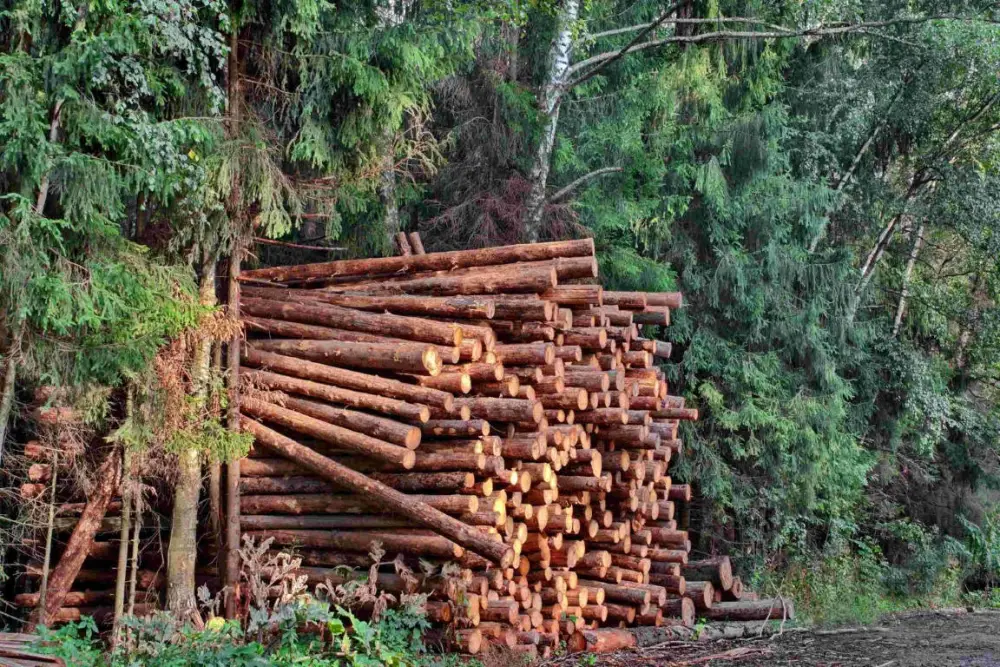
Bulgaria: Timber Output Hit Historic Low in 2025
Editor WoodBusinessPortal.com team - research, 2026 - June, 11
Industry Briefing for Wood Sector Professionals. In 2025, Bulgaria’s timber production registered a significant downturn, reaching a historic low that has rippled through the national wood supply chain and broader forestry-related markets. According to preliminary data from the Executive Forest Agency, the country harvested only around 80 % of the timber plantation volumes outlined in the national forestry management plans, amounting to approximately 30 % less than harvest volumes in 2018, the last year the harvesting plans were fully met.
Production Trends and Structural Challenges. The 2025 timber output reflects a continuing long-term decline in Bulgaria’s forest harvesting rates, influenced by reduced forest management activity, declining tree health, and increased forest-fire risks. This structural decline has consequences not just for raw material supply but also for wood-processing operations nationwide, where many firms have already reported diminished throughput and tighter margins due to constrained raw input.
Historical production assessment confirms that timber harvest peaks occurred earlier in the decade, with output trends sliding after 2018 — a pattern aligned with falling demand for biomass and reduced consumption in industry segments such as construction and traditional heating methods.
Imports and Trade Balance. With domestic timber production under pressure, Bulgaria continues to rely on imports of wood and wood products to sustain its industrial activity. According to the United Nations COMTRADE database, imports of wood, wood articles, and charcoal reached US $332.12 million in 2024, underscoring the sector’s dependence on external supplies to meet demand.
In parallel, export activity remains a strategic strength for the Bulgarian wood sector. Data from OEC World shows that in 2023, Bulgaria exported an estimated US $408 million in wood, wood articles, and charcoal, with primary destinations including Greece, Italy, and Germany — a testament to the country’s established integration within European wood commodity trade flows.
Price Dynamics and Import Costs. From a price perspective, Bulgaria’s import price index for wood, lumber, and cork indicates gentle inflationary pressures, with the import price index reaching 94.9 % year-over-year in December 2024, signaling modest cost increases for imported wood inputs.
Market Impacts and Forward Outlook. The historic low output of 2025 is prompting strategic reassessments across Bulgaria’s wood industry. Key implications include:
• Raw Material Scarcity: Tightened supply conditions may elevate prices for wholesale timber and push producers toward alternative sourcing strategies.
• Operational Adjustments: Wood processing firms may need to optimize inventories, invest in efficiency, and diversify product lines to mitigate raw material shortages.
• Policy and Forest Management: The need for enhanced forest management, reforestation schemes, and risk mitigation (e.g., fire and pest management) is increasingly urgent to improve both volume stability and sustainability.
Industry forecasts as per Bulgaria Forestry Industry Outlook 2024–2028 suggest continued pressure on forestry revenues and harvested volumes, with potential reductions in both domestic output and export capacity if sustainable interventions are not accelerated.
Conclusion. Bulgaria’s 2025 timber harvest contraction marks a pivotal moment for stakeholders in the wood industry. While exports remain a positive factor, the constrained supply environment and evolving price dynamics necessitate proactive planning, stronger forest resource governance, and adaptive sourcing strategies to sustain competitiveness. For detailed B2B market insights, price indexes, trade data, and forward-looking trend analysis, visit WoodBusinessPortal.com — your trusted source for comprehensive wood industry intelligence and actionable business data.
Sources:
1. bnrnews.bg
2. csd.eu
3. tradingeconomics.com
4. oec.world
5. reportlinker.com